Published July 31, 2026
Hetzner legacy pricing: why downsizing can raise your bill
 By Piotr Hajkowski
In this article
Hetzner gives you invoices and resource data, but it does not provide a built-in view that explains why your bill changed. You can build one in a spreadsheet, but collecting and matching the data is manual. CloudTally now offers a live public demo where you can follow a cost change from the chart to the affected resources. The chart might show compute up 18%, but the percentage alone cannot tell you whether someone added a server, the monthly price cap reset or a new price applied. You need to trace the change to its cause before deciding what to do.
The short version. Hetzner Cloud's change on 15 June 2026 left existing eligible servers on what Hetzner calls "legacy pricing". Before taking action in response to a higher bill, separate the effects of billing from those of infrastructure changes, and check whether rescaling would result in the loss of that price.
Open the CloudTally demo (opens in a new tab), then click "Open the demo" or start one of the four walkthroughs. This will give you a session, meaning that the links further down will open the exact views described in this post. Please note that the data is synthetic and read-only.
Hetzner legacy pricing survives until a trigger
Hetzner changed dedicated server and cloud server prices at 08:00 CEST on 15 June 2026. Eligible existing cloud servers kept their legacy price until certain customer actions triggered the current pricing. One such action is a rescale, Hetzner’s term for changing a cloud server to another size.
Hetzner's billing FAQ lists the triggers. Rescaling changes the price, whether you scale up or down. Restoring a deleted server and moving it to a project with a different currency also changes the price. However, rebuilding does not, nor does a project transfer that keeps the same currency.
The Hetzner API only shows today's catalogue price, which does not reflect the cost of long-running servers. CloudTally preserves price provenance and marks eligible resources as Price locked. The creation date and subsequent events are therefore as important as the server type. Hetzner's price-adjustment notice provides the effective date and price tables.
Some bill movements do not require a fix
Not every increase in a comparison indicates growth or waste. Two billing effects can alter a Hetzner total even when the infrastructure remains unchanged.
| What the Why column says | What happened | Action |
|---|---|---|
| Monthly cap reset | Hourly server charges started accumulating again after a monthly billing boundary. | None, unless the server itself is no longer needed. |
| Monthly price spread over more days | A monthly price was prorated across a calendar period with a different number of days. | None. Compare like periods. |
| Added resource | A server began generating cost in the current period. | Confirm its purpose, owner and expected lifetime. |
Hetzner bills a cloud server by the hour until its charge reaches the monthly price cap. Additional hours in that month add no server charge. At the start of the next month, hourly charges begin accumulating towards a new cap, as its billing FAQ explains. Two equal comparison periods can therefore have different costs even when the server has not changed. For resources with a monthly price, the daily share also depends on the number of days in the month, so February and January can show different daily costs without a resource change.
CloudTally names both effects in the Why column so you can understand the billing process. Those two movements require no action. However, idle resources do, and the filtered Resources view is where they appear. If you start the demo, select Hunt down the idle spend.
One driver turns the chart into an investigation
In the demo, open Why spend changed for 15 to 22 June, filtered to servers in the K8s Platform project. Start with the largest waterfall contribution and then read its driver row. The Why value distinguishes an added resource from a price or billing change. While it identifies the technical cause, it does not prove waste.
Clicking a chart bucket refocuses the summary and drivers table. Inspect opens the resource's cost history and event timeline. Check when it appeared, what happened next and whether it remains active. The bill change is now a concrete question for an engineer: was this server expected?
Try the same sequence in the price-change Explorer view.
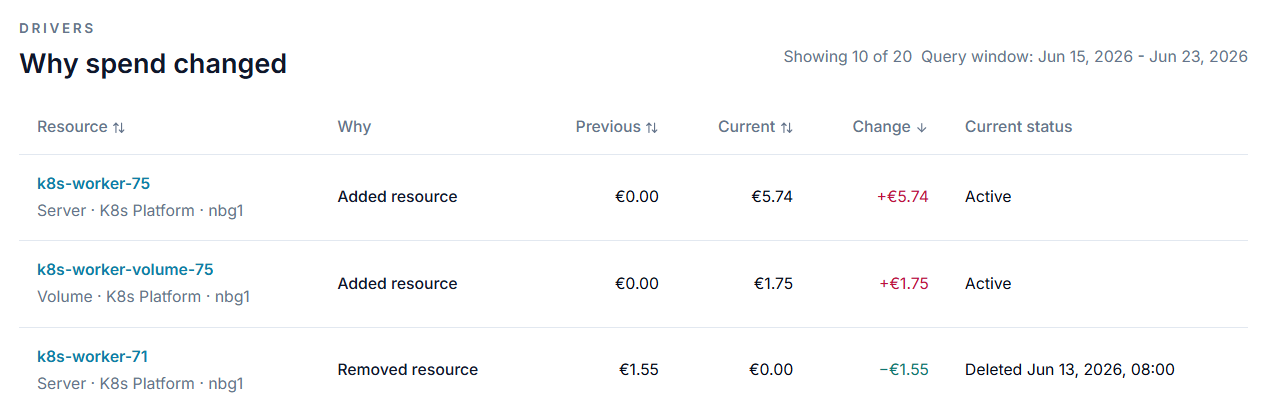
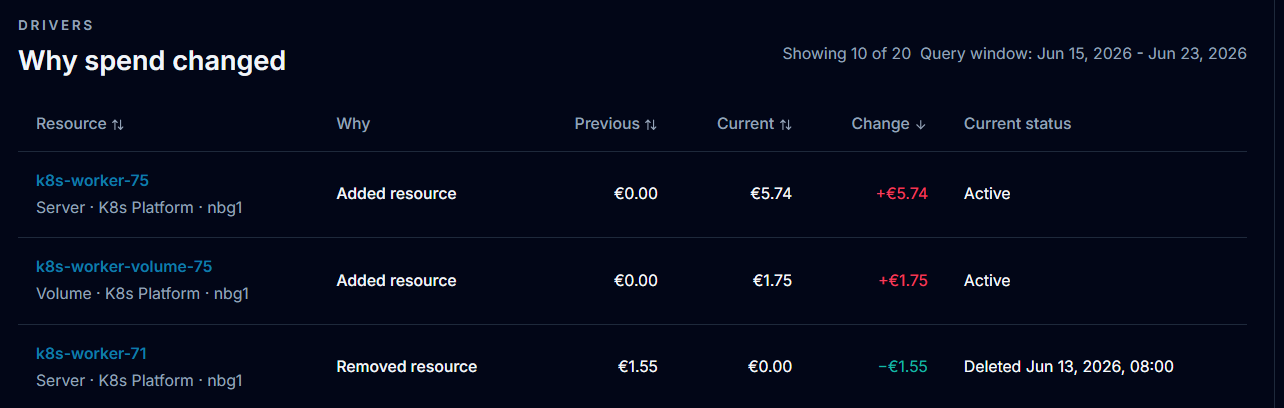
CloudTally's Why spend changed view connects the cost waterfall to the resources and reasons behind the change.
A smaller server can cost more than expected
Rightsizing can reverse the expected saving. Under legacy pricing, the CCX13 cost roughly half as much as the CCX23, so it appears that downsizing cuts the charge. In Germany and Finland, excluding VAT and IPv4, a CCX23 at its legacy price costs €31.49 a month. Rescaling it down to a CCX13 applies that plan's current €42.99 monthly price. The smaller server raises the bill by €11.50 a month, about 37%.
A price-aware recommendation must show the current effective price and the price after the rescale. CloudTally labels the trade-off Loses locked price when a recommendation would forfeit the legacy price. CloudTally surfaces the evidence; you make the change in Hetzner Cloud.
Five checks catch most Hetzner cost changes
- Compare two complete periods of the same length.
- Break down the total cost change before inspecting individual resources.
- Use the Why column explanation to identify the cause of each change.
- Check that the resource still exists and whether its state changed.
- Calculate the cost after any proposed action, including the legacy price you would lose.
These five checks cover the most common cases. They help you recognise normal billing-cycle effects and confirm that a proposed saving will actually reduce the bill.
A cost change should lead to a clear action
A Hetzner bill can rise because someone added a server, because the monthly cap reset, or because a rescale moved a resource off its legacy price. Only the first is worth acting on, and acting on the third can cost you €11.50 a month. Trace the change to its cause before you change anything.
More from the blog
Hetzner invoice wrong? How to verify every line yourself
Think Hetzner overcharged you? Verify every invoice line against the consumption CSV, resource IDs, and the activity log before you contact support.
Hetzner June 2026 price rise: How to keep costs low
On 15 June Hetzner raised prices for new orders and server changes, but existing servers keep their old price. Learn how to keep your bill low.